Follow Alaska's Trails -- On Your Own -- With Bearfoot Travel Magazines
Showing posts with label Alaska Farms & Gardens. Show all posts

Bearfoot Slideshows Of Eastern Alaska Rural Towns On The Richardson Highway

Video Of Delta Junction, Alaska


Things To See in Delta Junction

VIEW VIDEO BY PRESSING ARROW


ENLARGE VIDEO TO FULL SCREEN
BY PRESSING BOX ON BOTTOM RIGHT. 


Nasturtiums Fill Up The Bed Of A Truck In Chitina

Nasturtiums in unlikely place: back of old yellow truck.
The San Jose Steel Company Truck #43 found a home in Chitina, Alaska

Flower Gardens In Alaska Are Often Placed In Unusual Locations 

Alaskans love making flower beds out of all sorts of discarded functional items: old boats, chipped porcelain toilet bowls, gold dredge buckets. And, in Chitina, an old yellow truck.

The Corn Is As High As An Elephant's Eye In Talkeetna

Unusual crop in Alaska.
It's unusual to grow corn in Alaska!

Corn Is Hard To Grow In Alaska 

Alaska is a cool-weather crop kind of place, being so close to the Arctic, and all. So when the summer is warm enough to grow corn this tall, that means it's a great summer...

Every Spring, Hope Rises Anew For The Alaska Summer Growing Season: Looking At Alaska Life With Bearfoot

Winter seeding of plants for transplanting in the summer.
April 27th in Gakona, Alaska. 

Plants Growing Inside In April Bring Pungent Aroma Of Warm Earth 

Outside this window,  the snow is still thick on the ground in the Copper Valley of Alaska at the end of April. But indoors, carefully-tended zucchinis sprout in potting soil that was purchased at a Home Depot in Anchorage.

The smell of dirt is one of the things that Alaskans miss most during the long winter months. The Alaskan outdoors during the 8 months of winter has almost no smell -- other than hydrocarbon emissions wafting through the breeze in the larger cities. The actual terrain that makes up our world -- dirt, plants, trees, flowers, berries -- is completely covered for the entire duration of winter. In a way, it doesn't really exist until spring comes.

Smells -- especially fresh, natural smells, like trees and dirt -- require warmth. And warmth comes in June. For Alaskan gardeners, the earthy aroma that emanates from their hopeful little pots of seedlings is a sign that spring is coming, and that the underlying earth will be laid bare and burst into life once more.

Growing A Greenhouse In Alaska Is Difficult: Bearfoot Report

The problems of watering gardens in rural Alaska.
Water buckets near an Alaska greenhouse.

It's Hard To Get Water To Your Alaska Garden


A lot of rural Alaskans don't have a subterranean water source. Think about it. They don't live near a municipal water company, which pipes water under the ground. So they have to dig wells. If they don't have enough money to dig a well (Alaskan wells can be hundreds of feet deep) or if water is hard to find, then they have to haul water. You either haul water in jugs from a little pump house (if one of your neighbors has decided to provide one to the community) or you haul water on your pickup truck in a large plastic container especially made for the job. Or, there may be somebody living nearby, if you're lucky, who can bring water to you in a big water truck, something like a fuel truck takes gas to a gas station.

If you do have a well, the water is most likely just above freezing when it comes out of the tap, winter or summer. So you have to let it sit in a barrel or buckets outside, to let it warm up a bit before dumping it on your plants, and shocking and stunting their growth. These are water buckets to hold icy well water and let it warm up before use.


Bearfoot Talks About Feast Or Famine When You Grow Vegetable Gardens In Rural Alaska


Very large Alaskan zucchini on display at Sheep Mountain Lodge, Glenn Highway.
Gigantic zucchini from Palmer on display at
Sheep Mountain Lodge on the Glenn Highway. 

Some Alaskans Grow Huge Vegetables. Others Have A Very Difficult Time, Due To The State's Cold Summers

Huge vegetables are the byword of Alaska agriculture. And it's true -- especially in Palmer, Alaska's agricultural banana belt, that farmers carefully tend gigantic turnips, zucchini and cabbages, among other plants.

But, there's the flip side. In many parts of the state, growing any kind of vegetable, of any size, is considered a major achievement. In the Copper Valley, for example, where the average temperature, year-round, is 29 degrees above zero, growing vegetables can be a serious challenge, requiring major gardening skills.

Which most Alaskans do not have, no matter how long they live here.

Great Gardens In Alaska Require Great Gardeners, And Warm Summers


Bugs Aren't Usually The Problem. It's Lack Of Water & Cold Summers That Makes Gardening Tough In Alaska.             

Garden used to feed travelers at Denali Park hotels and restaurants.
A Tatlanika truck gardener grows vegetables for Denali Park hotels.


In many parts of America, bugs are a real problem for the average gardener. Aphids, cutworms, and a variety of beetles swoop down on the garden, attacking the plants. Also, in other parts of America, there are other problem pests, such as snail-like slugs.
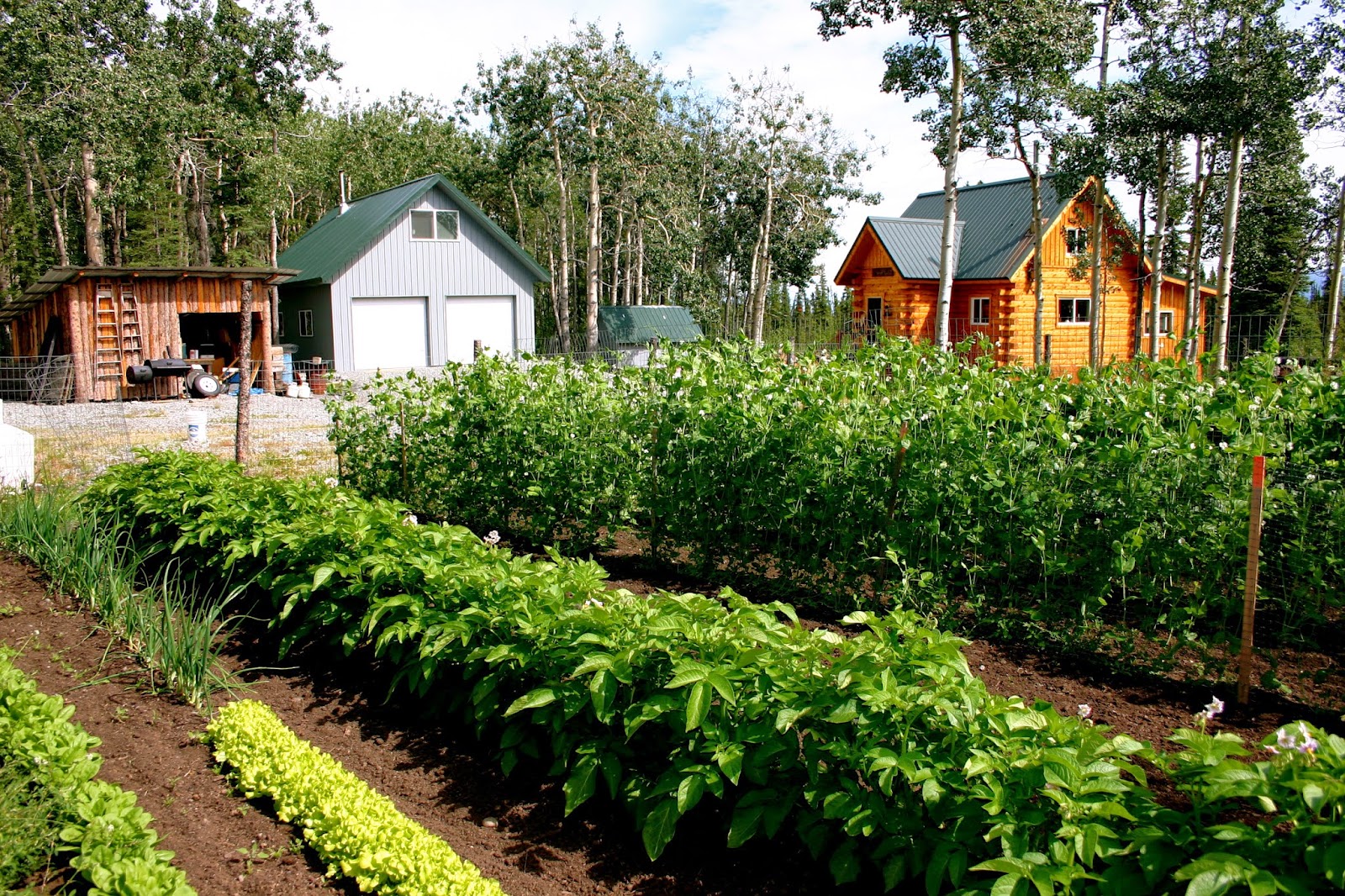
Log cabin homestead cabin and garden in Kenny Lake.
A lush, well-tended garden at a Kenny Lake,
 Alaska log cabin homestead.
Because Anchorage is so close to the shore and incoming pests -- and because Anchorage gardens are adjacent to each other and any bugs that do arrive can easily migrate -- you'll sometimes see some of these bugs, and slugs, in Anchorage. Especially in greenhouses.

But they are rare in the hinterlands of Alaska. They're rare for the same reason that earthworms are pretty much impossible to find here, too.  Bugs, earthworms, slugs... they would have to travel across hundreds of miles of spruce forest and swamp, through areas without a single potato, tomato, green pepper or lettuce to latch onto and destroy. They need a supply chain of vegetables along their route, like an army traveling across Alaska on its stomach. But, Alaska is so sparsely populated that a typical garden might be two, three, or even 15 or 20 miles away from the next garden. Pests simply have nowhere to resupply as they head cross-country.

Watering a homestead garden in rural Alaska.
A typical rural Alaska garden, in Eagle, along the Yukon.
Just as you'll never find an earthworm in Interior Alaska (unless you deliberately brought it there) and you'll never find a honeybee for the same reason, you won't find many of the typical bugs that have led to America's obsession with sprays, soap washes and outright lethal chemicals in the household garden.

The worst pests for gardeners in a typical Alaska vegetable garden are shrews, wild hares, and large ungulates, such as moose. 

This doesn't mean gardening in Alaska is easy. Alaskans have other problems.  The largest stem from the climate: Killing frosts, hard winds, cold rains, lack of rain, permafrost-frozen soil, and a lack of nutrients in the ground.

Bearfoot Report: "Alaska Grown": It's A Tough Row To Hoe, Finding Fresh Food

It's hit or miss, growing vegetables in the Alaska summer in the Interior. This is a summer's worth of tomatoes.


Much Closer To The Frozen Arctic Than To The Wheat Belt, Alaska Has Serious Problems Providing Its Own Food

Palmer steps up with produce for a local store.
The problems of growing food in Alaska is a very serious one. This is thousands of miles away from the American wheat and corn belts. In 1898, when the first American soldiers came to Alaska and walked up the Copper River, they were charged, in part, with finding out if agriculture was even possible in Alaska. The problems of producing food in Alaska is very real. This is not an easy place to grow things. It can freeze throughout much of the state any month of the year.

Eventually, there were farming areas, including at Palmer, Kenny Lake and Delta Junction. They all had varying degrees of success.
Because there were no indigenous livestock in Alaska -- no pigs, or horses, cows or domesticated sheep and goats -- Alaska's incoming westerners have extensively experimented with introducing the same livestock they brought to the "New World" centuries ago. But, in Alaska, due to the extreme cold, the natural, wild vegetation needed to feed cows and horses -- such as plentiful grass -- is almost non-existent in much of the state. Just feeding livestock remains a huge problem. This isn't the grasslands of the wild west, where steer and horses can "go wild" and forage on their own, even in the winter.

Horses needed hay and other feed that was grown by humans for them. So roadhouses sprang up all along Alaska's early trails. They had hayfields planted around them -- in effect providing "gas" to fuel the "engines" provided by horses, pulling wagons and sledges. Horsepower.
Then, outsiders began looking for farm-type animals that more closely matched the northern subarctic forage. For example, they brought in reindeer -- from other northern countries -- with the idea that the reindeer could provide meat and milk. And would be able to eat natural vegetation, such as lichens. The success of reindeer farming, introduced bison, and the introduction of musk oxen has been mixed.

Contact Us At Bearfoot

Bearfoot Travel Magazines A Division Of Northcountry Communications, Inc. Jeremy Weld Linda Weld Tim Weld 2440 East Tudor #122 Anchorage, Alaska 99507 ncountry@gci.net 907 320-1145 Fax: 1 800 478 8301